
- Safety
- 4
- of 5 stars
- Recalls
- 4
- on record
- MPG
- 35
- combined
Open recalls on record
4 safety recalls. Recall repairs are free at any franchised dealer — check the VIN before you buy.
Vehicle Summary
2017 Hyundai Elantra
Before You Buy
Safety record at a glance
- Recall campaigns
- 4
- Owner complaints
- 759
- Complaints citing a crash
- 36
These are raw counts from NHTSA records. They are not normalized by how many of these vehicles are on the road, so a model that sold in large numbers will tend to show more of everything. We do not publish a composite safety or reliability score.
4 Recalls on Record
These recalls have been issued by the manufacturer. Contact any authorized dealer to verify they have been completed — repairs are free.
Safety recalls
4 NHTSA campaigns affecting this model year.
- 17V213000high
Steering issue
STEERING:ELECTRIC POWER ASSIST SYSTEM
Hyundai Motor America (Hyundai) is recalling certain 2017 Elantra vehicles. The affected vehicles may have a damaged Electronic Power Steering (MDPS) connector resulting in a loss of electric power steering assistance.
Consequence
Loss of power steering assist would require higher steering effort, especially at lower speeds, which may increase the risk of a crash.
Full campaign recordRemedy
Hyundai will notify owners, and dealers will replace the EPS motor, free of charge. The recall is expected to begin April 28, 2017. Owners may contact Hyundai customer service at 1-800-243-7766. Hyundai's number for this recall 161.
- 16V956000high
Airbag system issue
AIR BAGS:FRONTAL:DRIVER SIDE:INFLATOR MODULE
Hyundai Motor Company (Hyundai) is recalling certain model year 2017 Hyundai Elantra vehicles manufactured April 15, 2016, to September 13, 2016, and Sonata vehicles manufactured May 27, 2016 to September 16, 2016. In these vehicles, the end seal for the driver's frontal air bag inflator may not have been properly installed, possibly resulting in reduced inflation of the frontal air bag in the event of a crash.
Consequence
In the event of a crash, an air bag that does not inflate fully increases the risk of injury.
Full campaign recordRemedy
Hyundai will notify owners, and dealers will replace the driver's frontal air bag module, free of charge. The recall began February 13, 2017. Owners may contact Hyundai customer service at 1-855-371-9460. Hyundai's number for this recall is 156.
- 17V063000high
Brake system issue
SERVICE BRAKES, HYDRAULIC:POWER ASSIST:HYDRAULIC
Hyundai Motor Company (Hyundai) is recalling certain 2017 Elantra vehicles. In the affected vehicles, the brake booster may fail, resulting in a loss of power brake assist.
Consequence
A loss of power brake assist can lengthen the distance needed to stop the vehicle, increasing the risk of a crash.
Full campaign recordRemedy
Hyundai has notified owners, and dealers will replace the brake system booster assembly, free of charge. The recall began on February 6, 2017. Owners may contact Hyundai customer service at 1-800-633-5151. Hyundai's number for this recall is 157.
- 16V232000high
Airbag system issue
AIR BAGS:FRONTAL
Hyundai Motor Company (Hyundai) is recalling certain model year 2015-2016 Sonata vehicles manufactured May 29, 2014 to February 11, 2016, 2017 Elantra vehicles manufactured January 12, 2016 to February 22, 2016, and one 2016 Sonata Hybrid vehicle manufactured October 15, 2015. In these vehicles, the driver's frontal air bag may be missing a chemical enhancer required for the second stage air bag deployment, resulting in the second stage not deploying in certain crashes. The primary stage will deploy as intended.
Consequence
An air bag that does not inflate increases the risk of injury.
Full campaign recordRemedy
Hyundai will notify owners, and dealers will replace the driver's frontal air bag module, free of charge. The recall began on May 5,2016. Owners may contact Hyundai customer service at 1-855-371-9460. Hyundai's number for this recall is 144.
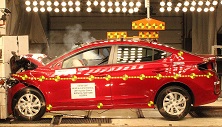
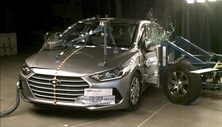
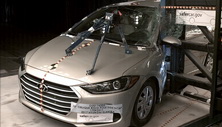
NHTSA crash-test ratings
NCAP star ratings and the underlying test breakdown for the 2017 Hyundai Elantra.
Frontal crash
- Driver
- 4 / 5
- Passenger
- 4 / 5
Side crash
- Driver
- 5 / 5
- Passenger
- 4 / 5
- Side pole
- 5 / 5
Rollover
- Rollover risk
- 10.7%
- Dynamic tip
- No Tip
Driver-assistance technologies
- Electronic stability control
- Standard
- Forward collision warning
- Optional
- Lane departure warning
- Optional
What the ratings mean
NHTSA gives the 2017 Hyundai Elantra 4 out of 5 stars overall, below the 5-star median for the 18 comparable 2017 vehicles NHTSA rated in this class.
NHTSA published results for every NCAP test in this program, so the overall star rating rests on a complete set of crash and rollover results.
NHTSA's dynamic test put this vehicle's rollover probability at 10.7% in a single-vehicle crash — the figure behind the rollover star rating, published here because the star alone hides how wide each band is.
Fuel economy & emissions
EPA figures for the 2017 Hyundai Elantra, with tailpipe CO₂ and class context.
32
City
40
Hwy
35
Comb
- Annual fuel cost
- $1,750
- Tailpipe CO₂
- 256 g/mi
How this compares
At 35 MPG combined, the 2017 Hyundai Elantra ranks 1st of 25 midsize cars EPA rated for 2017 — 10 MPG better than the 25 MPG median for that group.
That places it among the most efficient vehicles in its class. Fuel cost is unlikely to be the deciding factor against its direct rivals.
EPA puts annual fuel spend at about $1,750, $825 less than the $2,575 typical for the class. Over five years at 15,000 miles a year that is roughly $8,750, a $4,125 difference against a class-median vehicle.
Tailpipe CO₂ is 256 grams per mile — about 3.8 metric tons over 15,000 miles of driving.
Consumer complaints
759 owner reports filed with NHTSA.
- 759
- Total
- 36
- Crashes
- 6
- Fires
- 23
- Injuries
Most reported components
- ENGINE303
- OTHER119
- STRUCTURE114
- STEERING55
- ELECTRICAL49
Notable Issues
759 consumer complaints filed with NHTSA. 23 reports involve injuries. 36 reports involve a crash.
Most reported problems
Safety timeline
Every dated recall and NHTSA investigation for the 2017 Hyundai Elantra, newest first.
- Investigation closed
NHTSA closed investigation DP22003
Loss of Motive Power
- Investigation opened
NHTSA opened investigation DP22003
Loss of Motive Power
- Recall
Loss of power steering assist would require higher steering effort, especially at lower speeds, which may increase the risk of a crash.
- Recall
A loss of power brake assist can lengthen the distance needed to stop the vehicle, increasing the risk of a crash.
- Recall
In the event of a crash, an air bag that does not inflate fully increases the risk of injury.
- Recall
An air bag that does not inflate increases the risk of injury.
Dates are the NHTSA report-received date for recalls and the ODI open/close date for investigations. Crash-test ratings are not shown here because the source does not provide a reliable publication date for them.
Specifications & ratings
Specifications
- Body class
- Midsize Cars
- Drive type
- Front-Wheel Drive
- Engine
- 1.4L 4-cyl
- Fuel type
- Unknown
- Transmission
- Automatic (AM7)
- Seats
- 0
Fuel economy
32
City
40
Hwy
35
Comb
- Annual cost
- $1,750
- Fuel
- Regular Gasoline
NHTSA crash ratings
- Overall
- Frontal
- Side
- Rollover
Explore related
Compare with
Safety timeline
Full timeline- Investigation closed
NHTSA closed investigation DP22003
Loss of Motive Power
- Investigation opened
NHTSA opened investigation DP22003
Loss of Motive Power
- Recall
Loss of power steering assist would require higher steering effort, especially at lower speeds, which may increase the risk of a crash.
- Recall
A loss of power brake assist can lengthen the distance needed to stop the vehicle, increasing the risk of a crash.
- Recall
In the event of a crash, an air bag that does not inflate fully increases the risk of injury.