
- Safety
- 5
- of 5 stars
- Recalls
- 8
- on record
- MPG
- 28.7
- combined
Heavily recalled
8 safety recalls on record. Confirm with the seller that every campaign has been completed.
Vehicle Summary
2020 Chevrolet Bolt Ev
Before You Buy
Safety record at a glance
- Recall campaigns
- 8
- Owner complaints
- 171
- Complaints citing a crash
- 7
These are raw counts from NHTSA records. They are not normalized by how many of these vehicles are on the road, so a model that sold in large numbers will tend to show more of everything. We do not publish a composite safety or reliability score.
8 Recalls on Record
3 of these are high-severity. Contact a dealer to verify these have been completed.
Safety recalls
8 NHTSA campaigns affecting this model year.
- 20V184000high
Latches/locks/linkages · doors · latch
LATCHES/LOCKS/LINKAGES:DOORS:LATCH
General Motors LLC (GM) is recalling certain 2019-2020 Chevrolet Bolt EV vehicles. The door-handle cable inside the rear doors may be too long, allowing contact with the window when it is opened, possibly damaging the cable. A damaged cable may cause the rear door to open unintentionally when the rear window is opened. Additionally, it may cause the rear inside door handle to not work.
Consequence
If the rear door opens while driving, or the door handle fails to open the rear door, there is an increased risk of injury to the rear passengers.
Full campaign recordRemedy
GM will notify owners, and dealers will replace the rear inside door-handle cables, free of charge. The recall began April 17, 2020. Owners may contact Chevrolet customer service at 1-800-222-1020. GM's number for this recall is A202298320.
- 20V808000high
Brake system issue
SERVICE BRAKES, HYDRAULIC:FOUNDATION COMPONENTS:DISC:CALIPER
General Motors, LLC (GM) is recalling certain 2020 Chevrolet Bolt EV vehicles. These vehicles may have an improperly cast front left brake caliper that can fracture during a high-pressure braking event.
Consequence
If a brake caliper fractures and brake fluid is lost, the vehicle may experience reduced brake performance, increasing the risk of a crash.
Full campaign recordRemedy
GM will notify owners, and dealers will inspect the casting lot number on the front left brake caliper and replace it if necessary, free of charge. The recall began January 29, 2021. Owners may contact Chevrolet customer service at 1-800-222-1020. GM's number for this recall is N202321400.
- 20V811000high
Safety restraint issue
SEAT BELTS
General Motors, LLC (GM) is recalling certain 2020 Chevrolet Bolt EV and 2021 GMC Canyon and Sierra 1500, 2500 and 3500, Yukon, Yukon XL, Cadillac Escalade and Escalade ESV and Chevrolet Blazer, Camaro, Colorado, Equinox, Silverado 1500, 2500 and 3500, Suburban and Tahoe vehicles. Incorrect bolts may have been used at one or more fastening locations to secure the seat belts to the vehicle. If an incorrect bolt was used, the seat belt may not be properly attached to the vehicle.
Consequence
If a seat belt assembly is not properly attached to the vehicle, the seat belt may not properly restrain an occupant in the event of a crash, increasing the risk of injury.
Full campaign recordRemedy
GM will notify owners, and dealers will replace the suspect bolts, free of charge. The recall began January 29, 2021. Owners may contact GMC customer service at 1-800-462-8785, Cadillac customer service at 1-800-458-8006, or Chevrolet customer service at 1-800-222-1020. GM's number for this recall is N202322230.
- 21V650000high
Electrical issue
ELECTRICAL SYSTEM:PROPULSION SYSTEM:TRACTION BATTERY
General Motors, LLC (GM) is recalling certain 2020-2022 Chevrolet Bolt EV and 2022 Chevrolet Bolt EUV vehicles. The high voltage battery could catch fire when charged to full or nearly full capacity.
Consequence
A battery fire increases the risk of injury.
Full campaign recordRemedy
Owners are advised to take the following interim steps: Set the Target Charge Level feature in their vehicle to limit the charge level to 90%, charge their vehicle more frequently, avoid depleting the battery to 70 miles range remaining, park outside after charging, and do not charge the vehicle indoors overnight. Defective battery modules will be replaced by GM, free of charge. Owner notification letters were mailed on October 1, 2021 and June 23, 2023. Owners may contact the Bolt EV Concierge Team at 1-833-382-4389. This recall is an expansion of NHTSA recall 21V-560. GM's number for this recall is N212345940.
- 22V930000high
Body/structure issue
STRUCTURE:BODY:ROOF AND PILLARS
General Motors, LLC (GM) is recalling certain 2017-2023 Chevrolet Bolt EV vehicles. After a crash with seat belt pretensioner deployment, the pretensioner exhaust may ignite carpet fibers near the B-pillar, causing a fire.
Consequence
A vehicle fire can increase the risk of injury.
Full campaign recordRemedy
Dealers will install metal foil at the carpet near the pretensioner exhaust, and install a pretensioner cover as necessary, free of charge. Owner notification letters were mailed between January 23, 2023 and April 25, 2023. Owners may contact Chevrolet customer service at 1-800-222-1020. GM's number for this recall is N222383790.
- 23V845000high
Body/structure issue
STRUCTURE:BODY:ROOF AND PILLARS
General Motors, LLC (GM) is recalling certain 2017-2023 Chevrolet Bolt EV vehicles. This recall includes certain vehicles previously repaired incorrectly under NHTSA recall number 22V-930. After a crash with seat belt pretensioner deployment, the pretensioner exhaust may ignite carpet fibers near the B-pillar, causing a fire.
Consequence
A fire increases the risk of injury.
Full campaign recordRemedy
Dealers will inspect both front seat belt pretensioners and, if necessary, install metal foil at the carpet near the pretensioner exhaust. Certain vehicles will also need a pretensioner cover installed. Repairs will be performed free of charge. Owner notification letters were mailed January 24, 2024. These vehicles were previously recalled for this same issue under recall number 22V-930 and will need to have the new remedy performed. Owners may contact GM EV Concierge at 1-833-EVCHEVY (1-833-382-4389) (TTY 711 / 1-800-833-2438) or Customer Service at 1-800-222-1020. GM's number for this recall is N232421970.
- 24V481000high
Electrical issue
ELECTRICAL SYSTEM:PROPULSION SYSTEM:TRACTION BATTERY
General Motors, LLC (GM) is recalling certain 2020-2022 Chevrolet Bolt EV and 2022 Chevrolet Bolt EUV vehicles that were previously remedied under recall number 21V-650. The advanced diagnostic software may have been incorrectly installed and fail to detect defective battery modules, possibly resulting in a battery fire.
Consequence
A battery fire increases the risk of injury.
Full campaign recordRemedy
Owners are advised to take the following interim steps: Set the Target Charge Level feature in their vehicle to limit the charge level to 90%, charge their vehicle more frequently, avoid depleting the battery to 70 miles range remaining, park outside after charging, and do not charge the vehicle indoors overnight. Dealers will reinstall the advanced diagnostic software, free of charge. Owner notification letters were mailed on August 1, 2024. Owners may contact the Bolt EV Concierge Team at 1-833-382-4389. GM's numbers for this recall are N242443000 and N242443002.
- 24V812000high
Electrical issue
ELECTRICAL SYSTEM:PROPULSION SYSTEM:TRACTION BATTERY
General Motors, LLC (GM) is recalling certain 2020-2022 Chevrolet Bolt EV and 2022 Bolt EUV vehicles previously repaired under Recall 21V-650. The installation of advanced diagnostic software may have failed. As such, the high voltage battery could catch fire when charged to full or nearly full capacity.
Consequence
A battery fire increases the risk of injury.
Full campaign recordRemedy
Owners are advised to take the following interim steps: Set the Target Charge Level feature in their vehicle to limit the charge level to 90%, charge their vehicle more frequently, avoid depleting the battery to 70 miles range remaining, park outside after charging, and do not charge the vehicle indoors overnight. Dealers will reinstall advanced diagnostic software, free of charge. Owner notification letters were mailed December 3, 2024. Owners may contact the Bolt EV Concierge Team at 1-833-382-4389. GM's number for this recall is N242470160.
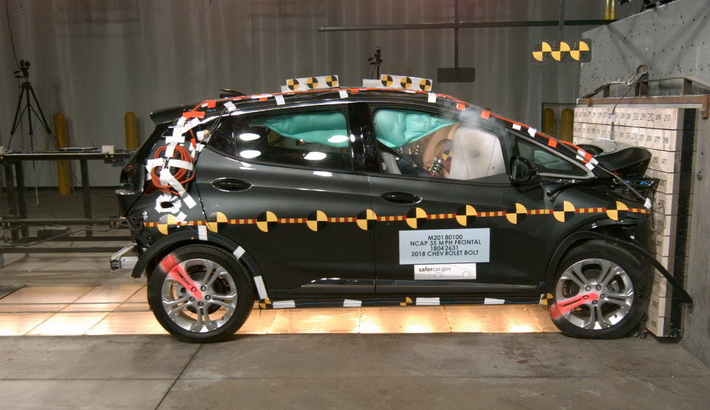
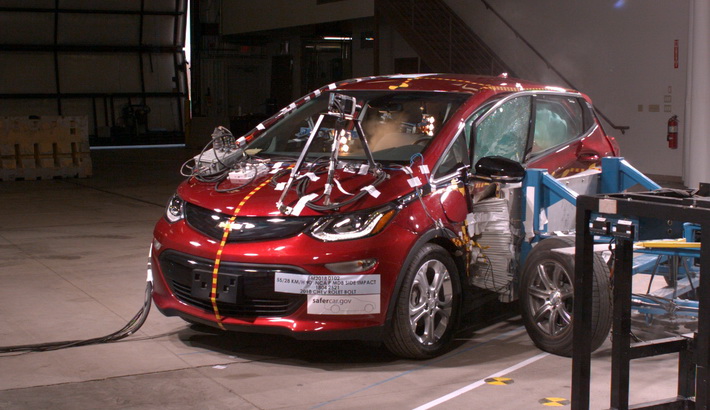
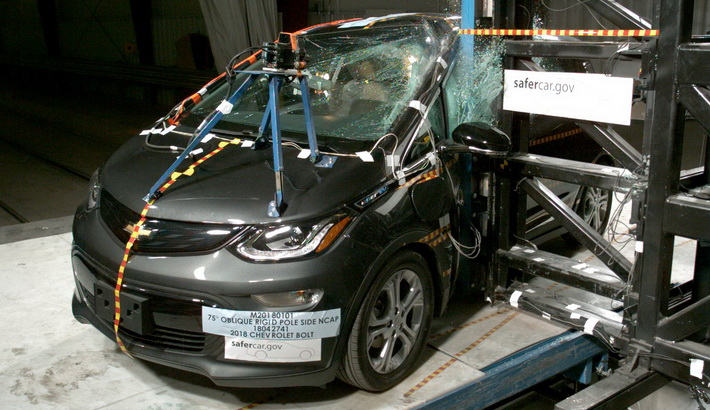
NHTSA crash-test ratings
NCAP star ratings and the underlying test breakdown for the 2020 Chevrolet Bolt Ev.
Frontal crash
- Driver
- 5 / 5
- Passenger
- 4 / 5
Side crash
- Driver
- 5 / 5
- Passenger
- 4 / 5
- Side pole
- 5 / 5
Rollover
- Rollover risk
- 9.7%
- Dynamic tip
- No Tip
Driver-assistance technologies
- Electronic stability control
- Standard
- Forward collision warning
- Optional
- Lane departure warning
- Optional
What the ratings mean
NHTSA gives the 2020 Chevrolet Bolt Ev 5 out of 5 stars overall. NHTSA does not publish enough comparable results for this class and year to rank it against peers.
NHTSA published results for every NCAP test in this program, so the overall star rating rests on a complete set of crash and rollover results.
NHTSA's dynamic test put this vehicle's rollover probability at 9.7% in a single-vehicle crash — the figure behind the rollover star rating, published here because the star alone hides how wide each band is.
Fuel economy & emissions
EPA figures for the 2020 Chevrolet Bolt Ev, with tailpipe CO₂ and class context.
28.7
City
31.3
Hwy
28.7
Comb
- Annual fuel cost
- $650
- Charge time
- 10 hours (240V)
How this compares
The EPA holds too few vehicles in this class and model year to rank the 2020 Chevrolet Bolt Ev against its peers.
Consumer complaints
171 owner reports filed with NHTSA.
- 171
- Total
- 7
- Crashes
- 4
- Fires
- 0
- Injuries
Most reported components
- ELECTRICAL69
- OTHER24
- STEERING21
- FUEL SYSTEM20
- ENGINE18
Notable Issues
171 consumer complaints filed with NHTSA. 7 reports involve a crash.
Most reported problems
Safety timeline
Every dated recall and NHTSA investigation for the 2020 Chevrolet Bolt Ev, newest first.
- Recall
A battery fire increases the risk of injury.
- Recall
A battery fire increases the risk of injury.
- Recall
A fire increases the risk of injury.
- Investigation closed
NHTSA closed investigation DP22005
Pedestrian alert sounds
- Investigation opened
NHTSA opened investigation DP22005
Pedestrian alert sounds
- Recall
A vehicle fire can increase the risk of injury.
- Investigation closed
NHTSA closed investigation PE20016
Electric Vehicle Battery Fires
- Recall
A battery fire increases the risk of injury.
- Recall
If a seat belt assembly is not properly attached to the vehicle, the seat belt may not properly restrain an occupant in the event of a crash, increasing the risk of injury.
- Recall
If a brake caliper fractures and brake fluid is lost, the vehicle may experience reduced brake performance, increasing the risk of a crash.
- Investigation opened
NHTSA opened investigation PE20016
Electric Vehicle Battery Fires
- Recall
If the rear door opens while driving, or the door handle fails to open the rear door, there is an increased risk of injury to the rear passengers.
Dates are the NHTSA report-received date for recalls and the ODI open/close date for investigations. Crash-test ratings are not shown here because the source does not provide a reliable publication date for them.
Specifications & ratings
Specifications
- Body class
- Small Station Wagons
- Drive type
- Front-Wheel Drive
- Engine
- 0L 0-cyl
- Fuel type
- Unknown
- Transmission
- Automatic (variable gear ratios)
- Seats
- 0
Fuel economy
28.7
City
31.3
Hwy
28.7
Comb
- Annual cost
- $650
- Fuel
- Electricity
NHTSA crash ratings
- Overall
- Frontal
- Side
- Rollover
Explore related
Safety timeline
Full timeline- Recall
A battery fire increases the risk of injury.
- Recall
A battery fire increases the risk of injury.
- Recall
A fire increases the risk of injury.
- Investigation closed
NHTSA closed investigation DP22005
Pedestrian alert sounds
- Investigation opened
NHTSA opened investigation DP22005
Pedestrian alert sounds