
- Safety
- 5
- of 5 stars
- Recalls
- 3
- on record
- MPG
- —
- combined
Fatalities reported
Owner complaints to NHTSA include 1 report involving a death. Read the complaint record closely.
Vehicle Summary
2017 Hyundai Tucson
Before You Buy
Safety record at a glance
- Recall campaigns
- 3
- Owner complaints
- 1,090
- Complaints citing a crash
- 13
These are raw counts from NHTSA records. They are not normalized by how many of these vehicles are on the road, so a model that sold in large numbers will tend to show more of everything. We do not publish a composite safety or reliability score.
3 Recalls on Record
1 of these is high-severity. Contact a dealer to verify these have been completed.
Safety recalls
3 NHTSA campaigns affecting this model year.
- 16V842000high
Wiring harness issue
ELECTRICAL SYSTEM:WIRING
Hyundai Motor America (Hyundai) is recalling certain model year 2016-2017 Tucson vehicles manufactured May 19, 2015, to November 14, 2016, and 2017 Santa Fe vehicles manufactured November 28, 2015, to November 14, 2016. The affected vehicles may be equipped with an accessory trailer hitch wiring harness that, due to a malfunction of the tow hitch module, may result, in the trailer brake lights being constantly illuminated. As such, these vehicles fail to comply with the requirements of Federal Motor Vehicle Safety Standard (FMVSS) number 108, " Lamps, Reflective Devices, and Associated Equipment."
Consequence
If the trailer brake lights stay illuminated while being used, other drivers may be confused, increasing the risk of a crash.
Full campaign recordRemedy
Hyundai will notify owners, and dealers will replace the affected accessory trailer hitch wiring harnesses, free of charge. The recall is expected to begin January 13, 2017. Owners may contact Hyundai customer service at 1-800-633-5151. Hyundai's number for this recall is 153.
- 21V727000high
Engine issue
ENGINE
Hyundai Motor America (Hyundai) is recalling certain 2017 Tucson and Sonata Hybrid vehicles. The connecting rod bearings inside the engine may wear prematurely, which can result in engine damage.
Consequence
A damaged engine can increase the risk of a fire or it can cause an engine stall, increasing the risk of a crash.
Full campaign recordRemedy
Dealers will inspect the engine. If bearing damage is found, the engine will be replaced. Dealers will also install a software update containing a new Knock Sensor Detection System (KSDS). Repairs will be performed free of charge. Owners were notified of the defect on November 16, 2021. Owner notification letters were mailed January 15, 2022. Owners may contact Hyundai customer service at 1-855-371-9460. Hyundai's number for this recall is 209.
- 20V543000high
Brake system issue
SERVICE BRAKES, HYDRAULIC:ANTILOCK/TRACTION CONTROL/ELECTRONIC LIMITED SLIP:CONTROL UNIT/MODULE
Hyundai Motor America (Hyundai) recalled certain 2019-2021 Tucson vehicles on September 4, 2020. On December 30, 2020, Hyundai expanded the recall population, and added certain 2016-2018 Tucson vehicles. The Anti-lock Brake Hydraulic Electronic Control Unit (HECU) could corrode internally and cause an electrical short, possibly resulting in an engine compartment fire.
Consequence
An engine compartment fire can increase the risk of injury or crash.
Full campaign recordRemedy
Hyundai will notify owners, and dealers will replace the HECU fuse. For 2019-2021 model years, the Electronic Stability Control (ESC) software will also be updated. Recall repairs will be performed free of charge. Owners are advised to park outside and away from structures as a precaution until the recall repair is complete. The recall began November 2, 2020. Owners may contact Hyundai customer service at 1-855-371-9460. Hyundai's number for this recall is 195.
NHTSA crash-test ratings
NCAP star ratings and the underlying test breakdown for the 2017 Hyundai Tucson.
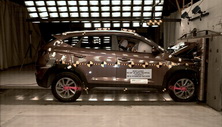
Frontal crash
- Driver
- 5 / 5
- Passenger
- 5 / 5
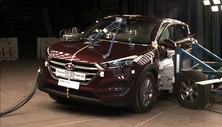
Side crash
- Driver
- 5 / 5
- Passenger
- 5 / 5
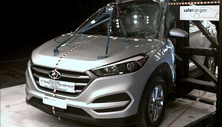
- Side pole
- 4 / 5
Rollover
- Rollover risk
- 16.2%
- Dynamic tip
- No Tip
Driver-assistance technologies
- Electronic stability control
- Standard
- Forward collision warning
- Optional
- Lane departure warning
- Optional
What the ratings mean
NHTSA gives the 2017 Hyundai Tucson 5 out of 5 stars overall. NHTSA does not publish enough comparable results for this class and year to rank it against peers.
NHTSA published results for every NCAP test in this program, so the overall star rating rests on a complete set of crash and rollover results.
NHTSA's dynamic test put this vehicle's rollover probability at 16.2% in a single-vehicle crash — the figure behind the rollover star rating, published here because the star alone hides how wide each band is.
Fuel economy & emissions
The EPA holds no fuel-economy record for this model year.
The EPA does not publish a record for every model year.
Consumer complaints
1,090 owner reports filed with NHTSA.
- 1,090
- Total
- 13
- Crashes
- 26
- Fires
- 14
- Injuries
Most reported components
- ENGINE813
- OTHER109
- BRAKES47
- STRUCTURE35
- ELECTRICAL33
Serious Concerns
1090 consumer complaints filed with NHTSA. 1 report involves a death. 14 reports involve injuries. 13 reports involve a crash.
Most reported problems
Safety timeline
Every dated recall and NHTSA investigation for the 2017 Hyundai Tucson, newest first.
- Investigation closed
NHTSA closed investigation EA21003
Engine Fires
- Investigation closed
NHTSA closed investigation DP22003
Loss of Motive Power
- Investigation opened
NHTSA opened investigation DP22003
Loss of Motive Power
- Investigation opened
NHTSA opened investigation EA21003
Engine Fires
- Recall
A damaged engine can increase the risk of a fire or it can cause an engine stall, increasing the risk of a crash.
- Recall
An engine compartment fire can increase the risk of injury or crash.
- Recall
If the trailer brake lights stay illuminated while being used, other drivers may be confused, increasing the risk of a crash.
Dates are the NHTSA report-received date for recalls and the ODI open/close date for investigations. Crash-test ratings are not shown here because the source does not provide a reliable publication date for them.
Specifications & ratings
Specifications
- Body class
- Unknown
- Drive type
- Unknown
- Engine
- 0L 0-cyl
- Fuel type
- Unknown
- Transmission
- Unknown
- Seats
- 0
NHTSA crash ratings
- Overall
- Frontal
- Side
- Rollover
Explore related
Systems recalled
Safety timeline
Full timeline- Investigation closed
NHTSA closed investigation EA21003
Engine Fires
- Investigation closed
NHTSA closed investigation DP22003
Loss of Motive Power
- Investigation opened
NHTSA opened investigation DP22003
Loss of Motive Power
- Investigation opened
NHTSA opened investigation EA21003
Engine Fires
- Recall
A damaged engine can increase the risk of a fire or it can cause an engine stall, increasing the risk of a crash.