
- Safety
- 5
- of 5 stars
- Recalls
- 9
- on record
- MPG
- 31
- combined
Do not drive until repaired
2 active "park it" recalls — NHTSA advises against driving this vehicle until the remedy is complete.
Vehicle Summary
2015 Hyundai Sonata
Before You Buy
Safety record at a glance
- Recall campaigns
- 9
- Owner complaints
- 1,128
- Complaints citing a crash
- 34
These are raw counts from NHTSA records. They are not normalized by how many of these vehicles are on the road, so a model that sold in large numbers will tend to show more of everything. We do not publish a composite safety or reliability score.
9 Recalls on Record
2 of these are high-severity. Some may require you to stop driving the vehicle until repaired.
Safety recalls
9 NHTSA campaigns affecting this model year.
- 16V726000high
Visibility issue
VISIBILITY:SUN/MOON ROOF ASSEMBLY
Hyundai Motor America (Hyundai) is recalling certain model year 2015-2016 Sonata Hybrid vehicles manufactured December 8, 2014, to August 18, 2015, and Hyundai Sonata vehicles manufactured May 28, 2014, to March 18, 2016, equipped with the panoramic sunroof option. Due to a bonding issue with the sunroof wind deflector, the sunroof panel on the affected vehicles may detach while driving.
Consequence
If the sunroof detaches from the vehicle it could become a road hazard, increasing the risk of a crash.
Full campaign recordRemedy
Hyundai will notify owners, and dealers will repair the wind deflector anchor plate, free of charge. The recall began December 2016. Owners may contact Hyundai customer service at 1-800-633-5151. Hyundai's number for this recall is 152.
- 17V359000high
Brake system issue
PARKING BRAKE:INDICATOR LIGHT
Hyundai Motor America (Hyundai) is recalling certain 2015-2016 Sonata and Genesis vehicles. In the affected vehicles, the warning light to indicate that the parking brake is applied may intermittently not illuminate in the dash due to corrosion in the switch.
Consequence
If the parking brake indicator is not illuminated when the parking brake is applied, the driver may operate the vehicle with the parking brake partially engaged, increasing the risk of a crash.
Full campaign recordRemedy
Hyundai will notify owners, and dealers will replace the parking brake switch, free of charge. The recall began on August 4, 2017. Owners may contact Hyundai customer service at 1-855-671-3059. Hyundai's number for this recall is 164.
- 16V232000high
Airbag system issue
AIR BAGS:FRONTAL
Hyundai Motor Company (Hyundai) is recalling certain model year 2015-2016 Sonata vehicles manufactured May 29, 2014 to February 11, 2016, 2017 Elantra vehicles manufactured January 12, 2016 to February 22, 2016, and one 2016 Sonata Hybrid vehicle manufactured October 15, 2015. In these vehicles, the driver's frontal air bag may be missing a chemical enhancer required for the second stage air bag deployment, resulting in the second stage not deploying in certain crashes. The primary stage will deploy as intended.
Consequence
An air bag that does not inflate increases the risk of injury.
Full campaign recordRemedy
Hyundai will notify owners, and dealers will replace the driver's frontal air bag module, free of charge. The recall began on May 5,2016. Owners may contact Hyundai customer service at 1-855-371-9460. Hyundai's number for this recall is 144.
- 15V678000high
Electrical issue
ELECTRICAL SYSTEM: INSTRUMENT CLUSTER/PANEL
Hyundai Motor America (Hyundai) is recalling certain model year 2015-2016 Sonata vehicles manufactured May 28, 2014, to August 21, 2015. The affected vehicles are equipped with an Antilock Braking System (ABS) warning light intended to warn the driver if there is an ABS malfunction. In the event of an ABS malfunction, the Brake System warning light will illuminate, but the ABS warning light will not illuminate. Since the vehicles have ABS malfunction lights that do not illuminate, these vehicles fail to comply with the requirements of Federal Motor Vehicle Safety Standard (FMVSS) number 135, "Light Vehicle Brake Systems."
Consequence
If the driver is alerted there is a brake system malfunction, but not specifically with the ABS system, the driver may operate the vehicle unaware that the vehicle's brakes may lock up during hard braking, increasing the risk of a crash.
Full campaign recordRemedy
Hyundai will notify owners, and dealers will update the ABS control unit software, free of charge. The recall is expected began on November 30, 2015. Owners may contact Hyundai customer service at 1-855-671-3059. Hyundai's number for this recall is 134.
- 15V414000high
Safety restraint issue
SEAT BELTS:FRONT:BUCKLE ASSEMBLY
Hyundai Motor America (Hyundai) is recalling certain model year 2015 Sonata vehicles manufactured April 25, 2014, to December 4, 2014. The affected vehicles have a front passenger seat belt whose buckle latch assembly may prevent the front passenger from fastening the seat belt.
Consequence
If the front passenger seat belt cannot be latched, an occupant sitting in the front passenger seat has an increased risk of injury in the event of a crash.
Full campaign recordRemedy
Hyundai will notify owners, and dealers will repair or replace the front passenger seat belt buckle, free of charge. The recall began on September 15, 2015. Owners may contact Hyundai customer service at 1-855-671-3059. Hyundai's number for this recall is 130.
- 14V368000critical Do not drive
Brake system issue
SERVICE BRAKES, HYDRAULIC:FOUNDATION COMPONENTS:DISC:CALIPER
Hyundai Motor Company (Hyundai) is recalling certain model year 2015 Sonata vehicles manufactured April 25, 2014, through June 16, 2014. Due to a manufacturing error, one or both of the front brake calipers may fracture.
Consequence
If a brake caliper fractures, brake effectiveness would be reduced, lengthening to distance required to stop the vehicle, increasing the risk of a crash.
Full campaign recordRemedy
Hyundai contacted the affected owners on June 19, 2014 and instructed them not to drive their vehicles. Hyundai dealers will replace the affected brake calipers, free of charge. The recall began on September 12, 2014. Owners may contact Hyundai customer service at 1-800-633-5151. Hyundai's number for this recall is 120.
- 14V325000critical Do not drive
Steering issue
STEERING
Hyundai Motor Company (Hyundai) is recalling certain model year 2015 Sonata vehicles manufactured May 2, 2014, through May 23, 2014. A poor connection within the vehicle's wiring harness may result in a reduction of steering assist from the vehicle's motor driven power steering system or the inability to move the vehicle's shifter from the Park position.
Consequence
The reduction of power steering assist can increase the steering effort needed, increasing the risk of a crash.
Full campaign recordRemedy
Hyundai notified dealers to suspend sales of affected Sonata vehicles and has published recall bulletin 14-01-024 providing a service procedure to repair the affected vehicles. On June 7, 2014 Hyundai began to contact the affected retail customers. Owners may contact Hyundai customer service at 1-800-633-5151. Hyundai's number for this recall is 119.
- 14V784000high
Drivetrain issue
POWER TRAIN:AXLE ASSEMBLY:AXLE SHAFT
Hyundai Motor America (Hyundai) is recalling certain 1.6 liter model year 2015 Sonata vehicles manufactured August 29, 2014, to October 28, 2014. The affected vehicles may have been assembled with an incorrect left axle shaft which may result in the shaft separating from the transaxle differential.
Consequence
If the left axle shaft separates from the transaxle, the vehicle may stop moving, increasing the risk of a crash. Additionally, a separated axle shaft may allow the vehicle to roll away as the driver and other occupants exit the vehicle or anytime thereafter. A vehicle rollaway increases the risk of injury to exiting occupants and bystanders.
Full campaign recordRemedy
Hyundai will notify owners, dealers will inspect and replace the axle shaft, as necessary, free of charge. Owners may contact Hyundai customer service at 1-800-633-5151. Hyundai's number for this recall is 126.
- 21V749000high
Lighting issue
EXTERIOR LIGHTING:TURN SIGNAL
Hyundai Motor America (Hyundai) is recalling certain 2015-2017 Sonata, 2016-2017 Sonata Hybrid, and Sonata Plug-In Hybrid vehicles. The Smart Junction Box (SJB) software logic may not properly interpret the signals received from the multifunction switch, which could cause the turn signal to activate in the opposite direction of what the driver intended.
Consequence
A turn signal that activates in the opposite direction of what was intended by the driver increases the risk of a crash.
Full campaign recordRemedy
Dealers will update the SJB software, free of charge. Owner notification letters were mailed November 19, 2021. Owners may contact Hyundai customer service at 1-855-371-9460. Hyundai's number for this recall is 210.
NHTSA crash-test ratings
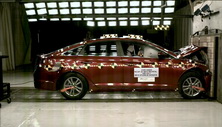
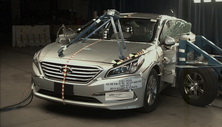
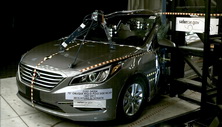
NCAP star ratings and the underlying test breakdown for the 2015 Hyundai Sonata.
Frontal crash
- Driver
- 5 / 5
- Passenger
- 5 / 5
Side crash
- Driver
- 5 / 5
- Passenger
- 5 / 5
- Side pole
- 5 / 5
Rollover
- Rollover risk
- 10.5%
- Dynamic tip
- No Tip
Driver-assistance technologies
- Electronic stability control
- Standard
- Forward collision warning
- Optional
- Lane departure warning
- Optional
What the ratings mean
NHTSA gives the 2015 Hyundai Sonata 5 out of 5 stars overall. NHTSA does not publish enough comparable results for this class and year to rank it against peers.
NHTSA published results for every NCAP test in this program, so the overall star rating rests on a complete set of crash and rollover results.
NHTSA's dynamic test put this vehicle's rollover probability at 10.5% in a single-vehicle crash — the figure behind the rollover star rating, published here because the star alone hides how wide each band is.
Fuel economy & emissions
EPA figures for the 2015 Hyundai Sonata, with tailpipe CO₂ and class context.
28
City
36
Hwy
31
Comb
- Annual fuel cost
- $2,000
- Tailpipe CO₂
- 286 g/mi
How this compares
At 31 MPG combined, the 2015 Hyundai Sonata ranks 1st of 6 large cars EPA rated for 2015 — 8.5 MPG better than the 22.5 MPG median for that group.
That places it in the upper third of its class. Fuel cost is unlikely to be the deciding factor against its direct rivals.
EPA puts annual fuel spend at about $2,000, $800 less than the $2,800 typical for the class. Over five years at 15,000 miles a year that is roughly $10,000, a $4,000 difference against a class-median vehicle.
Tailpipe CO₂ is 286 grams per mile — about 4.3 metric tons over 15,000 miles of driving.
Consumer complaints
1,128 owner reports filed with NHTSA.
- 1,128
- Total
- 34
- Crashes
- 47
- Fires
- 32
- Injuries
Most reported components
- ENGINE662
- OTHER101
- BRAKES77
- STEERING57
- ELECTRICAL48
Serious Concerns
1128 consumer complaints filed with NHTSA. 2 reports involve a death. 32 reports involve injuries. 34 reports involve a crash.
Most reported problems
Safety timeline
Every dated recall and NHTSA investigation for the 2015 Hyundai Sonata, newest first.
- Investigation closed
NHTSA closed investigation EA19001
Electrical overstress
- Investigation closed
NHTSA closed investigation EA21003
Engine Fires
- Investigation closed
NHTSA closed investigation DP22003
Loss of Motive Power
- Investigation closed
NHTSA closed investigation DP21003
Throttle control system vulnerabilities
- Investigation opened
NHTSA opened investigation DP22003
Loss of Motive Power
- Investigation opened
NHTSA opened investigation EA21003
Engine Fires
- Investigation opened
NHTSA opened investigation DP21003
Throttle control system vulnerabilities
- Recall
A turn signal that activates in the opposite direction of what was intended by the driver increases the risk of a crash.
- Investigation opened
NHTSA opened investigation EA19001
Electrical overstress
- Recall
If the parking brake indicator is not illuminated when the parking brake is applied, the driver may operate the vehicle with the parking brake partially engaged, increasing the risk of a crash.
- Recall
If the sunroof detaches from the vehicle it could become a road hazard, increasing the risk of a crash.
- Recall
An air bag that does not inflate increases the risk of injury.
- Recall
If the driver is alerted there is a brake system malfunction, but not specifically with the ABS system, the driver may operate the vehicle unaware that the vehicle's brakes may lock up during hard braking, increasing the risk of a crash.
- Recall
If the front passenger seat belt cannot be latched, an occupant sitting in the front passenger seat has an increased risk of injury in the event of a crash.
- Recall
If the left axle shaft separates from the transaxle, the vehicle may stop moving, increasing the risk of a crash. Additionally, a separated axle shaft may allow the vehicle to roll away as the driver and other occupants exit the vehicle or anytime thereafter. A vehicle rollaway increases the risk of injury to exiting occupants and bystanders.
- Do not drive
If a brake caliper fractures, brake effectiveness would be reduced, lengthening to distance required to stop the vehicle, increasing the risk of a crash.
- Do not drive
The reduction of power steering assist can increase the steering effort needed, increasing the risk of a crash.
Dates are the NHTSA report-received date for recalls and the ODI open/close date for investigations. Crash-test ratings are not shown here because the source does not provide a reliable publication date for them.
Specifications & ratings
Specifications
- Body class
- Large Cars
- Drive type
- Front-Wheel Drive
- Engine
- 1.6L 4-cyl
- Fuel type
- Unknown
- Transmission
- Automatic (AM7)
- Seats
- 0
Fuel economy
28
City
36
Hwy
31
Comb
- Annual cost
- $2,000
- Fuel
- Regular Gasoline
NHTSA crash ratings
- Overall
- Frontal
- Side
- Rollover
Explore related
Compare with
Systems recalled
Safety timeline
Full timeline- Investigation closed
NHTSA closed investigation EA19001
Electrical overstress
- Investigation closed
NHTSA closed investigation EA21003
Engine Fires
- Investigation closed
NHTSA closed investigation DP22003
Loss of Motive Power
- Investigation closed
NHTSA closed investigation DP21003
Throttle control system vulnerabilities
- Investigation opened
NHTSA opened investigation DP22003
Loss of Motive Power