
- Safety
- 5
- of 5 stars
- Recalls
- 8
- on record
- MPG
- 34
- combined
Heavily recalled
8 safety recalls on record. Confirm with the seller that every campaign has been completed.
Vehicle Summary
2018 Toyota Camry
Before You Buy
Safety record at a glance
- Recall campaigns
- 8
- Owner complaints
- 747
- Complaints citing a crash
- 46
These are raw counts from NHTSA records. They are not normalized by how many of these vehicles are on the road, so a model that sold in large numbers will tend to show more of everything. We do not publish a composite safety or reliability score.
8 Recalls on Record
These recalls have been issued by the manufacturer. Contact any authorized dealer to verify they have been completed — repairs are free.
Safety recalls
8 NHTSA campaigns affecting this model year.
- 19V503000high
Incorrect or missing label
EQUIPMENT:OTHER:LABELS
Southeast Toyota Distributors, LLC (SET) is recalling certain 2017-2019 Toyota Camry, Corolla, Rav4, Sienna, and Yaris iA vehicles equipped with factory-installed floor mats. The load carrying capacity modification label may be incorrect. As such, these vehicles fail to comply with the requirements of Federal Motor Vehicle Safety Standard (FMVSS) number 110, "Tire Selection and Rims."
Consequence
An incorrect label may lead to unintentionally overloading the vehicle, increasing the risk of a crash.
Full campaign recordRemedy
SET will notify owners and provide a corrected label for placement over the inaccurate label, free of charge. The recall began August 23, 2019. Owners may contact Toyota customer service at 1-888-270-9371. SET's number for this recall is SET19A.
- 18V108000high
Fuel system issue
FUEL SYSTEM, GASOLINE:DELIVERY:HOSES, LINES/PIPING, AND FITTINGS
Toyota Motor Engineering & Manufacturing (Toyota) is recalling certain 2018 Toyota Camry vehicles equipped with V6 engines. These vehicles have fuel delivery pipes that may not be properly connected to the fuel hoses in the engine compartment.
Consequence
The improperly connected hoses may leak fuel, which, in the presence of an ignition source, can increase the risk of a fire.
Full campaign recordRemedy
Toyota will notify owners, and dealers will inspect the fuel pipes for the correct installation, correcting them as necessary, free of charge. The recall is expected to begin March 30, 2018. Owners may contact Toyota customer service at 1-888-270-9371. Toyota's number for this recall is J0G.
- 18V200000high
Engine issue
ENGINE AND ENGINE COOLING:ENGINE
Toyota Motor Engineering & Manufacturing (Toyota) is recalling certain 2018 Toyota Camry vehicles equipped with a 2.5L, four-cylinder engine. The pistons on these vehicles may be larger than specified, possibly causing the engine to stall.
Consequence
An engine stall can increase the risk of a crash.
Full campaign recordRemedy
Toyota will notify owners, and dealers will inspect the production date codes of the pistons and, if an engine contains a piston from the affected production period, the engine assembly will be replaced, free of charge. The recall is expected to begin May 25, 2018. Owners may contact Toyota customer service at 1-888-270-9371. Toyota's number for this recall is J1M/J0M.
- 18V211000high
Brake system issue
SERVICE BRAKES, HYDRAULIC:POWER ASSIST:VACUUM
Toyota Motor Engineering & Manufacturing (Toyota) is recalling certain 2018 Toyota Camry and Highlander vehicles, 2017 Toyota Sienna and Tacoma vehicles and 2017 Lexus RX350 vehicles. During the manufacturing process, the oil galley in the rotor for the brake booster vacuum pump assembly may have been improperly machined possibly resulting in a sudden loss of brake assist.
Consequence
A sudden loss of braking assist can increase the risk of a crash.
Full campaign recordRemedy
Toyota will notify owners, and dealers will replace the brake booster vacuum pump, free of charge. The recall began on May 9, 2018. Owners may contact Toyota customer service at 1-888-270-9371, or Lexus customer service at 1-800-255-3987. Toyota's numbers for this recall are J0K/JLD.
- 20V682000high
Fuel pump may fail
FUEL SYSTEM, GASOLINE:DELIVERY:FUEL PUMP
Toyota Motor Engineering & Manufacturing (Toyota) is recalling certain 2018-2019 4Runner, 2019-2020 Avalon, 2019 Corolla Hatchback, 2017-2019 Highlander, 2018-2020 Camry, 2020 Corolla, 2018-2019 Land Cruiser, 2017-2020 Tacoma, 2019-2020 RAV4, 2019-2020 Sequoia, 2017-2020 Sienna, 2019-2020 Tundra, 2018-2020 Lexus ES350, 2017 Lexus GS200t, 2017-2019 Lexus GS350, 2019 Lexus GS300, 2018-2020 Lexus LC500h, 2019-2020 Lexus LS500, 2018-2019 Lexus GX460, 2017 Lexus IS200t, 2019 Lexus IS300, 2019 Lexus IS350, 2018-2020 Lexus LC500, 2018 Lexus LS500, 2019 Lexus LS500h, 2018-2019 Lexus LX570, 2017 Lexus RC200t, 2019 Lexus RC300, RC350, 2017 and 2019-2020 Lexus RX350, 2018-2020 RX350L, 2019 Lexus UX200, 2018-2019 Lexus NX300 vehicles. The low-pressure fuel pump inside the fuel tank may fail.
Consequence
If the fuel pump fails, the engine can stall while driving, increasing the risk of a crash.
Full campaign recordRemedy
Toyota will notify owners, and dealers will replace the fuel pump assembly with an improved one, free of charge. Owners of specific models were notified that remedy parts were available starting January 21, 2021. Owners of other models will be notified as remedy parts become available. Remedy parts should be available for all affected vehicles by late March 2021. Owners may contact Toyota customer service at 1-888-270-9371 or Lexus customer service at 1-800-255-3987. Note: This recall is an expansion of recall 20V-012. Toyota's number for this recall is 20TA02. Lexus' number for this recall is 20LA01.
- 21V890000high
Brake system issue
SERVICE BRAKES, HYDRAULIC:POWER ASSIST:VACUUM
Toyota Motor Engineering & Manufacturing (Toyota) is recalling certain 2018-2019 Camry vehicles. The vane cap inside the vacuum pump may break, causing the pump to fail, which could result in a sudden loss of braking assist.
Consequence
A sudden loss of braking assist can increase the risk of a crash.
Full campaign recordRemedy
Dealers will repair or replace the vacuum pump, as necessary, free of charge. Owner notification letters were mailed May 16, 2022. Owners may contact Toyota customer service at 1-800-331-4331.
- 20V012000high
Fuel pump may fail
FUEL SYSTEM, GASOLINE:DELIVERY:FUEL PUMP
Toyota Motor Engineering & Manufacturing (Toyota) recalled certain 2018-2019 4Runner, Highlander, Camry, Land Cruiser, Sequoia, Sienna, Tacoma and Tundra, and Lexus RC 300, RC 350, GS 350, GX 460, IS 300, LC 500, LS 500, LX 570, RX 350L, and 2019 Toyota Avalon and Corolla, and certain Lexus NX 300, and ES 350 vehicles on January 13, 2020. On March 4, 2020, Toyota expanded the recall to include certain 2014-2015 Toyota 4Runner and Land Cruiser, 2018 Avalon, Corolla, 2014 FJ Cruiser, 2017 Sienna and Lexus 2018 ES 350, 2018-2019 GS 300, 2013-2014 GS350, 2014-2015 GX 460, IS 350 and LX 570, 2014 IS F, 2018-2019 IS 350, LC 500H and LS 500H, 2013-2015 LS 460, 2015 NX 200T and RC350, 2017 RC 200T and RX 350. Toyota also removed the 2018-2019 Toyota 4Runner and Land Cruiser and 2018-2019 Lexus GX 460 and LX 570 and 2019 NX300 from inclusion in this recall. On March 19, 2020, Toyota expanded the recall to include 2015 Lexus GS350 vehicles. The low-pressure fuel pump inside the fuel tank may fail.
Consequence
If the fuel pump fails, the engine can stall while driving, increasing the risk of a crash.
Full campaign recordRemedy
Toyota will notify owners, and dealers will replace the fuel pump, free of charge. The recall began May 4, 2020. Owners may contact Toyota customer service at 1-888-270-9371 or Lexus customer service at 1-800-255-3987. Toyota's numbers for this recall are 20TB02 and 20TA02 for Toyota vehicles and 20LB01 and 20LA01 for Lexus vehicles.
- 25V028000high
Fuel pump may fail
FUEL SYSTEM, GASOLINE:DELIVERY:FUEL PUMP
Toyota Motor Engineering & Manufacturing (Toyota) is recalling certain 2018 Camry, 2019 Lexus NX300, and 2019 RX350L vehicles. The low-pressure fuel pump inside the fuel tank may fail.
Consequence
Fuel pump failure can cause an engine stall, increasing the risk of a crash.
Full campaign recordRemedy
Dealers will replace the fuel pump assembly, free of charge. Owner notification letters were mailed March 12, 2025. Owners may contact Toyota's customer service at 1-800-331-4331. Toyota's numbers for this recall are 25TA01 and 25LA01.
NHTSA crash-test ratings
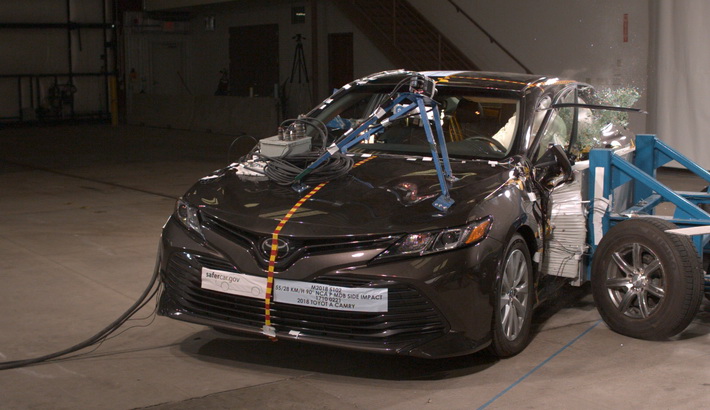
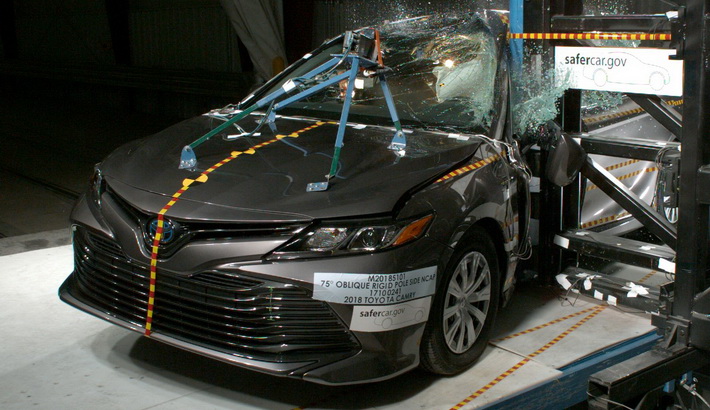
NCAP star ratings and the underlying test breakdown for the 2018 Toyota Camry.
Frontal crash
- Driver
- 5 / 5
- Passenger
- 5 / 5
Side crash
- Driver
- 5 / 5
- Passenger
- 5 / 5
- Side pole
- 5 / 5
Rollover
- Rollover risk
- 9.9%
- Dynamic tip
- No Tip
Driver-assistance technologies
- Electronic stability control
- Standard
- Forward collision warning
- No
- Lane departure warning
- Standard
What the ratings mean
NHTSA gives the 2018 Toyota Camry 5 out of 5 stars overall, level with the 5-star median for the 16 comparable 2018 vehicles NHTSA rated in this class.
NHTSA published results for every NCAP test in this program, so the overall star rating rests on a complete set of crash and rollover results.
NHTSA's dynamic test put this vehicle's rollover probability at 9.9% in a single-vehicle crash — the figure behind the rollover star rating, published here because the star alone hides how wide each band is.

Fuel economy & emissions
EPA figures for the 2018 Toyota Camry, with tailpipe CO₂ and class context.
29
City
41
Hwy
34
Comb
- Annual fuel cost
- $1,950
- Tailpipe CO₂
- 264 g/mi
How this compares
At 34 MPG combined, the 2018 Toyota Camry ranks 1st of 24 midsize cars EPA rated for 2018 — 7.5 MPG better than the 26.5 MPG median for that group.
That places it among the most efficient vehicles in its class. Fuel cost is unlikely to be the deciding factor against its direct rivals.
EPA puts annual fuel spend at about $1,950, $850 less than the $2,800 typical for the class. Over five years at 15,000 miles a year that is roughly $9,750, a $4,250 difference against a class-median vehicle.
Tailpipe CO₂ is 264 grams per mile — about 4 metric tons over 15,000 miles of driving.
Consumer complaints
747 owner reports filed with NHTSA.
- 747
- Total
- 46
- Crashes
- 4
- Fires
- 45
- Injuries
Most reported components
- ENGINE269
- BRAKES161
- OTHER73
- FUEL SYSTEM68
- STEERING52
Notable Issues
747 consumer complaints filed with NHTSA. 45 reports involve injuries. 46 reports involve a crash.
Most reported problems
Safety timeline
Every dated recall and NHTSA investigation for the 2018 Toyota Camry, newest first.
- Recall
Fuel pump failure can cause an engine stall, increasing the risk of a crash.
- Recall
A sudden loss of braking assist can increase the risk of a crash.
- Recall
If the fuel pump fails, the engine can stall while driving, increasing the risk of a crash.
- Recall
If the fuel pump fails, the engine can stall while driving, increasing the risk of a crash.
- Recall
An incorrect label may lead to unintentionally overloading the vehicle, increasing the risk of a crash.
- Recall
A sudden loss of braking assist can increase the risk of a crash.
- Recall
An engine stall can increase the risk of a crash.
- Recall
The improperly connected hoses may leak fuel, which, in the presence of an ignition source, can increase the risk of a fire.
Dates are the NHTSA report-received date for recalls and the ODI open/close date for investigations. Crash-test ratings are not shown here because the source does not provide a reliable publication date for them.
Specifications & ratings
Specifications
- Body class
- Sedan
- Drive type
- FWD
- Engine
- 2.5L 4-cyl
- Fuel type
- Regular Gasoline
- Transmission
- Automatic
- Seats
- 5
Fuel economy
29
City
41
Hwy
34
Comb
- Annual cost
- $1,950
- Fuel
- Regular Gasoline
NHTSA crash ratings
- Overall
- Frontal
- Side
- Rollover
Explore related
Compare with
Systems recalled
Safety timeline
Full timeline- Recall
Fuel pump failure can cause an engine stall, increasing the risk of a crash.
- Recall
A sudden loss of braking assist can increase the risk of a crash.
- Recall
If the fuel pump fails, the engine can stall while driving, increasing the risk of a crash.
- Recall
If the fuel pump fails, the engine can stall while driving, increasing the risk of a crash.
- Recall
An incorrect label may lead to unintentionally overloading the vehicle, increasing the risk of a crash.