
- Safety
- 4
- of 5 stars
- Recalls
- 6
- on record
- MPG
- —
- combined
Open recalls on record
6 safety recalls. Recall repairs are free at any franchised dealer — check the VIN before you buy.
Vehicle Summary
2017 Jeep Cherokee
Before You Buy
Safety record at a glance
- Recall campaigns
- 6
- Owner complaints
- 1,336
- Complaints citing a crash
- 24
These are raw counts from NHTSA records. They are not normalized by how many of these vehicles are on the road, so a model that sold in large numbers will tend to show more of everything. We do not publish a composite safety or reliability score.
6 Recalls on Record
These recalls have been issued by the manufacturer. Contact any authorized dealer to verify they have been completed — repairs are free.
Safety recalls
6 NHTSA campaigns affecting this model year.
- 20V343000high
Drivetrain issue
POWER TRAIN:DRIVELINE:DIFFERENTIAL UNIT
Chrysler (FCA US LLC) is recalling certain 2014-2017 Jeep Cherokee vehicles equipped with a two-speed Power Transfer Unit (PTU). Relative movement in the Power Transfer Unit (PTU) between the differential input splines and the transmission output shaft may cause some input spline teeth to wear off, which may eventually cause a loss of engagement between the transmission and the differential inside the PTU. If this occurs, power cannot be transferred between the front wheels and the transmission which results in a loss of drive while the vehicle is in motion and a loss of the Park function while stationary.
Consequence
A loss of drive can cause a vehicle crash without prior warning. A loss of the Park function can cause unintended vehicle rollaway which can increase the risk of a crash or injury.
Full campaign recordRemedy
FCA US LLC will notify owners, and dealers will perform a software update that will maintain vehicle propulsion by engaging rear wheel drive and prevent rolling in Park by activating the electronic parking brake if a failed input spline occurs. This recall began July 14, 2020. Owners may contact FCA USA LLC customer service at 1-800-853-1403. FCA's number for this recall is W47.
- 18V332000high
Wiring harness issue
ELECTRICAL SYSTEM:WIRING
Chrysler (FCA US LLC) is recalling certain 2014-2018 Dodge Journey, Charger and Durango, RAM 2500, 3500, 3500 Cab Chassis (more than 10,000lb), 4500 Cab Chassis and 5500 Cab Chassis, Jeep Cherokee and Grand Cherokee and Chrysler 300, 2014-2019 RAM 1500, 2015-2018 Dodge Challenger, 2015-2017 Chrysler 200, 2016-2018 RAM 3500 Cab Chassis (less than 10,000 lb), 2017-2018 Chrysler Pacifica and 2018 Jeep Wrangler vehicles. These vehicles are being recalled to address a defect that could prevent the cruise control system from disengaging. If, when using cruise control, there is a short circuit within the vehicle's wiring, the driver may not be able to shut off the cruise control either by depressing the brake pedal or manually turning the system off once it has been engaged, resulting in either the vehicle maintaining its current speed or possibly accelerating.
Consequence
If the vehicle maintains its speed or accelerates despite attempts to deactivate the cruise control, there would be an increased risk of a crash.
Full campaign recordRemedy
Chrysler will notify owners, and dealers will inspect the software, and perform a software flash on the engine or powertrain control module, free of charge. The recall began June 4, 2018. Owners may contact Chrysler customer service at 1-800-853-1403. Note: Owners are advised to stop using cruise control until the software update has been performed. In the event that cruise control cannot be disengaged while driving, owners should firmly and steadily apply the brakes and shift the transmission to neutral, placing the vehicle in park once it has stopped.
- 17V543000high
Incorrect or missing label
EQUIPMENT:OTHER:LABELS
Chrysler (FCA US LLC) is recalling certain 2017-2018 Jeep Cherokee vehicles. The tire and rim size information required to be on the Certification label was omitted during manufacturing, which may result in an incorrect tire and rim combination being installed on the vehicle. As such, these vehicles fail to comply with the requirements of Federal Motor Vehicle Safety Standard (FMVSS) number 110, "Tire Selection and Rims."
Consequence
The missing tire and rim designation information may lead to an incorrect combination being installed on the vehicle, increasing the risk of a crash.
Full campaign recordRemedy
Chrysler will notify owners and will provide a corrected certification label, free of charge. The recall began October 13, 2017. Owners may contact Chrysler customer service at 1-800-853-1403. Chrysler's number for this recall is T53.
- 16V799000high
Airbag system issue
AIR BAGS:KNEE BOLSTER
Chrysler (FCA US LLC) is recalling certain model year 2017 Jeep Cherokee vehicles manufactured October 13, 2016, to October 17, 2016. Improper welds on the driver's knee air bag inflator may prevent the air bag from properly inflating.
Consequence
If the driver's knee air bag does not properly inflate, there is an increased risk of injury in the event of a crash.
Full campaign recordRemedy
Chrysler will notify owners, and dealers will replace the driver's knee air bag module, free of charge. The recall began November 9, 2016. Owners may contact Chrysler customer service at 1-800-853-1403. Chrysler's number for this recall is S84.
- 23V302000high
Drivetrain issue
POWER TRAIN:AUTOMATIC TRANSMISSION
Chrysler (FCA US, LLC) is recalling certain 2016-2017 Jeep Cherokee vehicles. The power transfer unit (PTU) may become damaged and disengage the transmission and differential, resulting in a loss of drive power or loss of park function.
Consequence
A loss of drive power can increase the risk of a crash. A loss of park function can cause an unintended vehicle rollaway which can increase the risk of a crash or injury.
Full campaign recordRemedy
FCA US LLC will notify owners, and dealers will perform a software update, free of charge. Owner notification letters were mailed May 11, 2023. Owners may contact FCA USA LLC customer service at 1-800-853-1403. FCA's number for this recall is 45A. This recall expands previous recall number 20V-343.
- 25V011000high
Drivetrain issue
POWER TRAIN
Chrysler (FCA US, LLC) is recalling certain 2017-2019 Jeep Cherokee vehicles. The power transfer unit (PTU) may become damaged and disengage the transmission and differential, resulting in a loss of drive power and/or loss of park function.
Consequence
A loss of drive power can increase the risk of a crash. A loss of park function can cause an unintended vehicle rollaway, which can increase the risk of a crash or injury.
Full campaign recordRemedy
Dealers will update the drivetrain control module and PTU software and replace the PTU, as necessary free of charge. Owner notification letters were mailed beginning February 19, 2026. Owners may contact FCA customer service at 1-800-853-1403. FCA's number for this recall is 01C.
NHTSA crash-test ratings
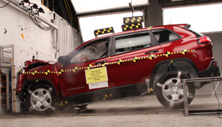
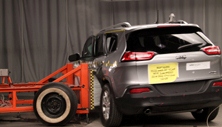
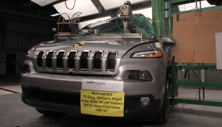
NCAP star ratings and the underlying test breakdown for the 2017 Jeep Cherokee.
Frontal crash
- Driver
- 4 / 5
- Passenger
- 4 / 5
Side crash
- Driver
- 5 / 5
- Passenger
- 5 / 5
- Side pole
- 5 / 5
Rollover
- Rollover risk
- 16.9%
- Dynamic tip
- No Tip
Driver-assistance technologies
- Electronic stability control
- Standard
- Forward collision warning
- Optional
- Lane departure warning
- Optional
What the ratings mean
NHTSA gives the 2017 Jeep Cherokee 4 out of 5 stars overall. NHTSA does not publish enough comparable results for this class and year to rank it against peers.
NHTSA published results for every NCAP test in this program, so the overall star rating rests on a complete set of crash and rollover results.
NHTSA's dynamic test put this vehicle's rollover probability at 16.9% in a single-vehicle crash — the figure behind the rollover star rating, published here because the star alone hides how wide each band is.
Fuel economy & emissions
The EPA holds no fuel-economy record for this model year.
The EPA does not publish a record for every model year.
Consumer complaints
1,336 owner reports filed with NHTSA.
- 1,336
- Total
- 24
- Crashes
- 6
- Fires
- 27
- Injuries
Most reported components
- ENGINE809
- OTHER226
- ELECTRICAL162
- BRAKES61
- AIR BAGS26
Notable Issues
1336 consumer complaints filed with NHTSA. 27 reports involve injuries. 24 reports involve a crash.
Most reported problems
Safety timeline
Every dated recall and NHTSA investigation for the 2017 Jeep Cherokee, newest first.
- Recall
A loss of drive power can increase the risk of a crash. A loss of park function can cause an unintended vehicle rollaway, which can increase the risk of a crash or injury.
- Recall
A loss of drive power can increase the risk of a crash. A loss of park function can cause an unintended vehicle rollaway which can increase the risk of a crash or injury.
- Investigation opened
NHTSA opened investigation EA21002
Desiccated Air Bag Inflator Rupture
- Recall
A loss of drive can cause a vehicle crash without prior warning. A loss of the Park function can cause unintended vehicle rollaway which can increase the risk of a crash or injury.
- Recall
If the vehicle maintains its speed or accelerates despite attempts to deactivate the cruise control, there would be an increased risk of a crash.
- Recall
The missing tire and rim designation information may lead to an incorrect combination being installed on the vehicle, increasing the risk of a crash.
- Recall
If the driver's knee air bag does not properly inflate, there is an increased risk of injury in the event of a crash.
Dates are the NHTSA report-received date for recalls and the ODI open/close date for investigations. Crash-test ratings are not shown here because the source does not provide a reliable publication date for them.
Specifications & ratings
Specifications
- Body class
- Unknown
- Drive type
- Unknown
- Engine
- 0L 0-cyl
- Fuel type
- Unknown
- Transmission
- Unknown
- Seats
- 0
NHTSA crash ratings
- Overall
- Frontal
- Side
- Rollover
Explore related
Systems recalled
Safety timeline
Full timeline- Recall
A loss of drive power can increase the risk of a crash. A loss of park function can cause an unintended vehicle rollaway, which can increase the risk of a crash or injury.
- Recall
A loss of drive power can increase the risk of a crash. A loss of park function can cause an unintended vehicle rollaway which can increase the risk of a crash or injury.
- Investigation opened
NHTSA opened investigation EA21002
Desiccated Air Bag Inflator Rupture
- Recall
A loss of drive can cause a vehicle crash without prior warning. A loss of the Park function can cause unintended vehicle rollaway which can increase the risk of a crash or injury.
- Recall
If the vehicle maintains its speed or accelerates despite attempts to deactivate the cruise control, there would be an increased risk of a crash.