
- Safety
- 4
- of 5 stars
- Recalls
- 7
- on record
- MPG
- —
- combined
Open recalls on record
7 safety recalls. Recall repairs are free at any franchised dealer — check the VIN before you buy.
Vehicle Summary
2019 Jeep Grand Cherokee
Before You Buy
Safety record at a glance
- Recall campaigns
- 7
- Owner complaints
- 356
- Complaints citing a crash
- 17
These are raw counts from NHTSA records. They are not normalized by how many of these vehicles are on the road, so a model that sold in large numbers will tend to show more of everything. We do not publish a composite safety or reliability score.
7 Recalls on Record
These recalls have been issued by the manufacturer. Contact any authorized dealer to verify they have been completed — repairs are free.
Safety recalls
7 NHTSA campaigns affecting this model year.
- 20V191000high
Rear-visibility system issue
BACK OVER PREVENTION: SENSING SYSTEM: CAMERA
Chrysler (FCA US LLC) is recalling certain 2020 Jeep Gladiator and Jeep Cherokee, 2019-2020 Ram 1500 Pickup, Ram 2500 Pickup, Ram 3500 Pickup, Chrysler Pacifica, Dodge Durango, Jeep Grand Cherokee, Jeep Wrangler, and Jeep Renegade and 2019 Dodge Challenger vehicles equipped with 8.4" or 12" radio displays. A software error can cause the rearview camera image to remain displayed after the vehicle has been shifted out of reverse. As such, these vehicles fail to comply with the requirements of Federal Motor Vehicle Safety Standard (FMVSS) number 111, "Rearview Mirrors."
Consequence
The lingering rearview image can distract the driver, increasing the risk of a crash.
Full campaign recordRemedy
Chrysler has notified owners, and dealers will update the radio display software, free of charge. Optionally, owners can choose to remotely update their software via an Over-The-Air (OTA) update available as of May 1, 2020. The recall began April 27, 2020. Owners may contact Chrysler customer service at 1-800-853-1403. Chrysler's number for this recall is W30-W37.
- 20V699000high
Engine issue
ENGINE AND ENGINE COOLING:EXHAUST SYSTEM:EMISSION CONTROL:GAS RECIRCULATION VALVE (EGR VALVE)
Chrysler (FCA US LLC) is recalling certain 2014-2019 Jeep Grand Cherokee vehicles equipped with the 3.0L EcoDiesel engines. The Exhaust Gas Recirculation (EGR) cooler may crack and allow pre-heated vaporized coolant to enter the EGR system. This mixture may combust inside the intake manifold.
Consequence
Combustion in the intake manifold can increase the risk of a fire.
Full campaign recordRemedy
FCA US LLC will notify owners, and dealers will replace the EGR cooler, free of charge. Dealers will also inspect and, as necessary, replace the intake manifold. Parts are not currently available. Owners were mailed an interim notification on December 21, 2021. A second notification will be mailed when parts are available, currently expected to be around March 11, 2021. The recall began March 11, 2021. Owners may contact FCA US LLC customer service at 1-800-853-1403. FCA US LLC's number for this recall is W79.
- 20V183000high
Drivetrain issue
POWER TRAIN:DRIVELINE:DIFFERENTIAL UNIT
Chrysler (FCA US LLC) is recalling certain 2019 Jeep Grand Cherokee and Dodge Durango vehicles. The front differential may have been assembled with pinion gears that are insufficiently hardened, which can lead to the gear teeth wearing down. If both pinion gears have their teeth sufficiently worn off, torque power can not be transferred from the front wheels to the driveline, resulting in loss of power while driving and loss of the PARK function when stationary.
Consequence
A sudden loss of power while driving or loss of the transmission PARK function can increase the risk of a crash.
Full campaign recordRemedy
Chrysler will notify owners, and dealers will replace the front differential, free of charge. The recall began May 21, 2020. Owners may contact Chrysler customer service at 1-800-853-1403. Chrysler's number for this recall is W22.
- 22V406000high
Fuel system issue
FUEL SYSTEM, DIESEL:DELIVERY:FUEL PUMP
Chrysler (FCA US, LLC) is recalling certain 2014-2020 Jeep Grand Cherokee, and 2014-2019 Ram 1500 vehicles equipped with 3.0L diesel engines. A high pressure fuel pump (HPFP) failure may introduce internal debris into the fuel system, potentially resulting in fuel starvation.
Consequence
Fuel starvation may result in an unexpected loss of drive power, increasing the risk of a crash.
Full campaign recordRemedy
Dealers will replace the HPFP, and inspect and replace, if necessary, additional fuel system components, free of charge. Interim notification letters informing owners of the safety risk were mailed July 21, 2022. Owner notification letters for were mailed for Jeep Grand Cherokee owners starting January 11, 2024. Owner notification letters for Ram 1500 owners were mailed March 7, 2024. Owners may contact FCA US, LLC customer service at 1-800-853-1403. FCA US, LLS's number for this recall is Z46.
- 22V426000high
Brake system issue
SERVICE BRAKES, HYDRAULIC:ANTILOCK/TRACTION CONTROL/ELECTRONIC LIMITED SLIP:CONTROL UNIT/MODULE
Chrysler (FCA US, LLC) is recalling certain 2018-2019 Jeep Grand Cherokee and Dodge Durango vehicles. A malfunction in the antilock-brake system (ABS) module may illuminate the brake lights, and allow the vehicle to start and shift out of Park without the brake pedal being applied.
Consequence
A vehicle that starts and shifts out of Park without applying the brake pedal can result in vehicle rollaway, increasing the risk of a crash without prior warning and/or injury to others outside of the vehicle.
Full campaign recordRemedy
This recall is replaced by NHTSA recall number 24V838. Vehicles already repaired under this recall will need to have the new remedy completed. The remedy includes updated HCU/ABS module software that prevents the HCU/ABS module from falsely reading pressure in the primary circuit. FCA has decided to do a two-Phase Campaign remedy schedule. Phase 1 began November 17, 2022. Phase 2 begin date has not been determined yet. Interim owner notification letters explaining the safety risk were mailed July 28, 2020. Owner notification letters were mailed on November 29, 2022. Owners may contact FCA US, LLC customer service at 1-800-853-1403. FCA US, LLC's number for this recall is Z48.
- 23V411000high
Engine issue
ENGINE AND ENGINE COOLING
Chrysler (FCA US, LLC) is recalling certain 2014-2019 Ram 1500 and 2014-2020 Jeep Grand Cherokee vehicles equipped with 3.0L Diesel engines. The crankshaft position sensor tone wheel may delaminate, causing the engine to lose its ability to synchronize the fuel injector pulses and cam shaft timing, possibly resulting in an engine stall.
Consequence
An engine stall can increase the risk of a crash.
Full campaign recordRemedy
Dealers will update the powertrain control module software to maintain vehicle propulsion, free of charge. Interim notification letters, notifying owners of the safety risk, were mailed August 3, 2023. Some owner notification letters were mailed October 31, 2023. The remaining owner notification letters will be mailed at a future date, anticipated July 2024. Owners may contact FCA US, LLC customer service at 1-800-853-1403. FCA US, LLC's number for this recall is 66A. This recall is an expansion of recall 20V-475.
- 24V838000high
Brake system issue
SERVICE BRAKES, HYDRAULIC:ANTILOCK/TRACTION CONTROL/ELECTRONIC LIMITED SLIP:CONTROL UNIT/MODULE
Chrysler (FCA US, LLC) is recalling certain 2018-2019 Jeep Grand Cherokee and Dodge Durango vehicles. A malfunction in the antilock-brake system (ABS) module may incorrectly illuminate the brake lights and disable the ABS and electronic stability control (ESC). In addition, the vehicle operator may be able to start and shift out of Park without the brake pedal being applied.
Consequence
A vehicle that can be started and shifted out of Park without applying the brake pedal can result in a vehicle rollaway. Disabled ABS and ESC systems can reduce vehicle handling and control in certain driving situations. Brake lights that incorrectly illuminate can fail to properly indicate the driver's intention to following traffic. Any of these scenarios can increase the risk of a crash.
Full campaign recordRemedy
Dealers will replace the integrated pressure transducer and update the ABS module software, as necessary free of charge. Owner notification letters were mailed December 16, 2025. Owners may contact FCA customer service at 1-800-853-1403. FCA's number for this recall is 94B. This recall replaces previous recall number 22V-426. Vehicles previously remedied under 22V-426 will need to have the new remedy completed.
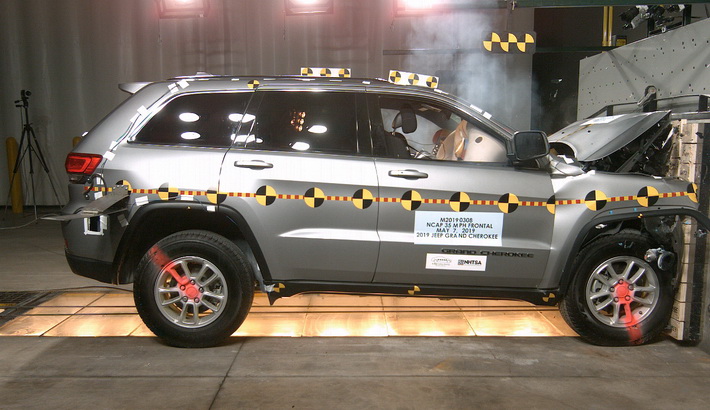
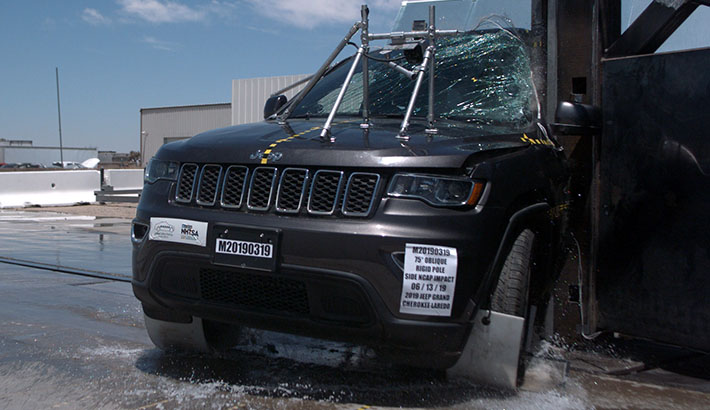
NHTSA crash-test ratings
NCAP star ratings and the underlying test breakdown for the 2019 Jeep Grand Cherokee.
Frontal crash
- Driver
- 4 / 5
- Passenger
- 5 / 5
Side crash
- Driver
- 5 / 5
- Passenger
- 5 / 5
- Side pole
- 5 / 5
Rollover
- Rollover risk
- 20.4%
- Dynamic tip
- No Tip
Driver-assistance technologies
- Electronic stability control
- Standard
- Forward collision warning
- Optional
- Lane departure warning
- Optional
What the ratings mean
NHTSA gives the 2019 Jeep Grand Cherokee 4 out of 5 stars overall. NHTSA does not publish enough comparable results for this class and year to rank it against peers.
NHTSA published results for every NCAP test in this program, so the overall star rating rests on a complete set of crash and rollover results.
NHTSA's dynamic test put this vehicle's rollover probability at 20.4% in a single-vehicle crash — the figure behind the rollover star rating, published here because the star alone hides how wide each band is.
NHTSA crash tests

Fuel economy & emissions
The EPA holds no fuel-economy record for this model year.
The EPA does not publish a record for every model year.
Consumer complaints
356 owner reports filed with NHTSA.
- 356
- Total
- 17
- Crashes
- 3
- Fires
- 9
- Injuries
Most reported components
- BRAKES111
- ENGINE81
- OTHER49
- ELECTRICAL48
- AIR BAGS18
Notable Issues
356 consumer complaints filed with NHTSA. 9 reports involve injuries. 17 reports involve a crash.
Most reported problems
Safety timeline
Every dated recall and NHTSA investigation for the 2019 Jeep Grand Cherokee, newest first.
- Investigation closed
NHTSA closed investigation PE19014
Active Head Rest Inadvertent Deployment
- Recall
A vehicle that can be started and shifted out of Park without applying the brake pedal can result in a vehicle rollaway. Disabled ABS and ESC systems can reduce vehicle handling and control in certain driving situations. Brake lights that incorrectly illuminate can fail to properly indicate the driver's intention to following traffic. Any of these scenarios can increase the risk of a crash.
- Recall
An engine stall can increase the risk of a crash.
- Investigation opened
NHTSA opened investigation EA23001
High pressure fuel pump failure
- Recall
Fuel starvation may result in an unexpected loss of drive power, increasing the risk of a crash.
- Recall
A vehicle that starts and shifts out of Park without applying the brake pedal can result in vehicle rollaway, increasing the risk of a crash without prior warning and/or injury to others outside of the vehicle.
- Investigation opened
NHTSA opened investigation EA21002
Desiccated Air Bag Inflator Rupture
- Recall
Combustion in the intake manifold can increase the risk of a fire.
- Recall
The lingering rearview image can distract the driver, increasing the risk of a crash.
- Recall
A sudden loss of power while driving or loss of the transmission PARK function can increase the risk of a crash.
- Investigation opened
NHTSA opened investigation PE19014
Active Head Rest Inadvertent Deployment
Dates are the NHTSA report-received date for recalls and the ODI open/close date for investigations. Crash-test ratings are not shown here because the source does not provide a reliable publication date for them.
Specifications & ratings
Specifications
- Body class
- Unknown
- Drive type
- Unknown
- Engine
- 0L 0-cyl
- Fuel type
- Unknown
- Transmission
- Unknown
- Seats
- 0
NHTSA crash ratings
- Overall
- Frontal
- Side
- Rollover
Explore related
Safety timeline
Full timeline- Investigation closed
NHTSA closed investigation PE19014
Active Head Rest Inadvertent Deployment
- Recall
A vehicle that can be started and shifted out of Park without applying the brake pedal can result in a vehicle rollaway. Disabled ABS and ESC systems can reduce vehicle handling and control in certain driving situations. Brake lights that incorrectly illuminate can fail to properly indicate the driver's intention to following traffic. Any of these scenarios can increase the risk of a crash.
- Recall
An engine stall can increase the risk of a crash.
- Investigation opened
NHTSA opened investigation EA23001
High pressure fuel pump failure
- Recall
Fuel starvation may result in an unexpected loss of drive power, increasing the risk of a crash.